2026-10-13 ·
Why Is Your Refrigerator Leaking Water? Causes and Solutions
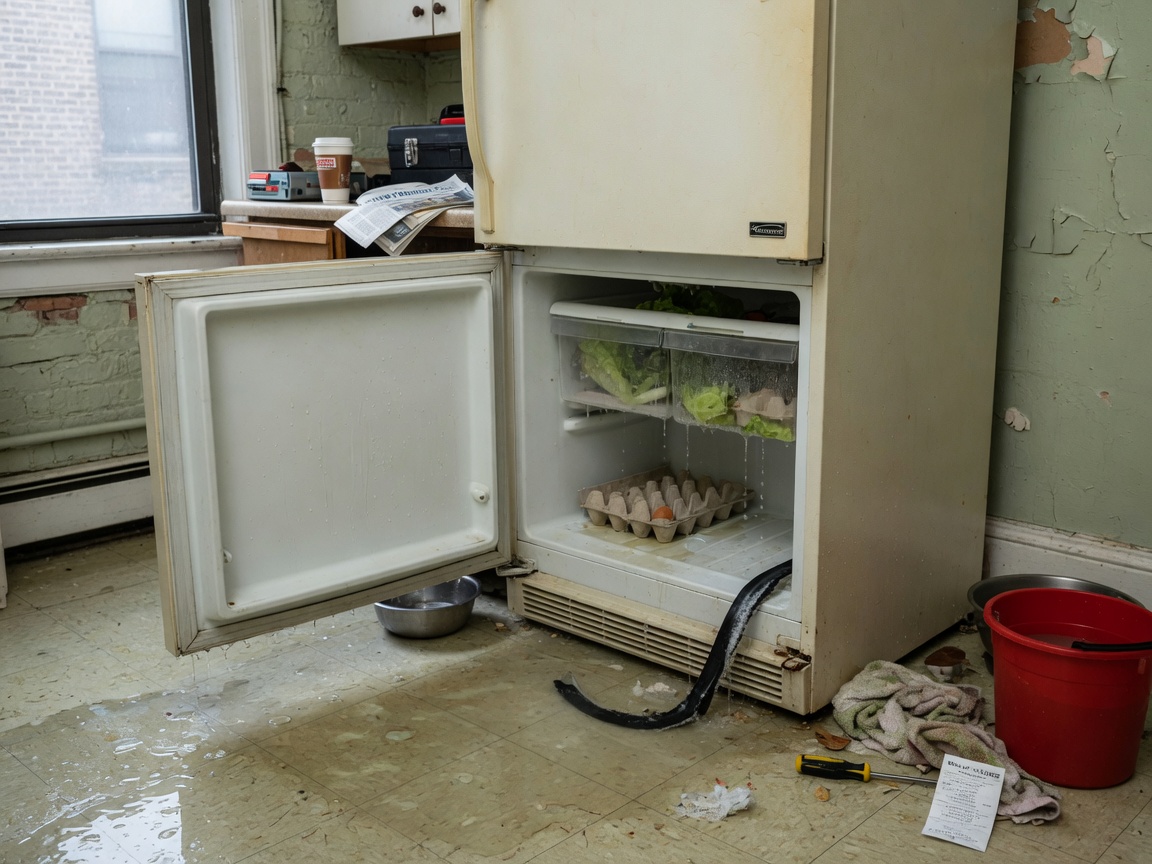
A refrigerator that leaks is usually dealing with one of three things: a defrost drain that has clogged and backed water onto the floor, a water supply line to the icemaker or dispenser that has cracked or loosened, or a door gasket or internal seal that no longer keeps humid air out. A clogged drain repair often costs $0–$150 if you handle it yourself, while a replacement supply line typically runs $100–$300 with labor. Finding the true source first is what keeps a small puddle from becoming a warped subfloor.
The Defrost Drain Is the Most Common Culprit
Most refrigerators built in the last 20 years are frost-free, meaning a heating element periodically melts the ice on the evaporator coil. The meltwater runs into a drain tube that drops to a shallow pan above the compressor, where it evaporates. When that tube fills with food debris, mold, or a sheet of ice, water has nowhere to go and spills out the bottom of the unit, usually at the front of the cabinet.
In Chicago, this shows up most in older kitchens in Lincoln Park, Wicker Park, and Logan Square, where many units have been pushed back against plaster walls for years. Homes in these neighborhoods often have older floors that slope slightly, so water runs toward the front and pools there.
To check it, pull the refrigerator out and look at the back wall near the bottom for the drain pan. If the pan is overflowing or the floor behind the unit is wet, pour a cup of warm water slowly down the drain outlet inside the freezer and watch whether it drains. A clog that doesn't clear with warm water usually needs a thin brush or a technician.
Check the Water Supply Line and Icemaker Connection
If your refrigerator has an icemaker or water dispenser, a second leak source sits behind the unit: the small plastic or copper supply line that feeds it. These lines are often installed tightly during delivery, and when the fridge gets pushed in and out for cleaning, the compression fittings can loosen. Over time the plastic can also become brittle and crack, especially where it bends near the back panel.
Look for drips or a damp patch on the kitchen floor directly behind the fridge, and check the fittings at the wall valve and the back of the unit. A slow drip that appears only when the icemaker fills is a strong clue. Shutting off the saddle or angle valve under the sink before you move the appliance prevents a small leak from becoming a flood.
Replacing the line is one of the more manageable repairs if you are comfortable with basic tools, though a dedicated tubing kit is inexpensive, usually under $30. Be sure the new line has enough slack to avoid kinking when the refrigerator sits back in place.
Look at the Door Gasket and Internal Seals
Water that appears inside the fridge, on shelf glass, or on the bottom of crisper drawers is often a condensation problem rather than a true leak. The door gasket is the soft magnetic seal around the cabinet. When it is cracked, dirty, or no longer making full contact, warm humid air from the kitchen gets in and condenses on cold surfaces. Chicago's humid continental climate makes this worse in July and August, when kitchen humidity climbs and the compressor works harder.
Test the gasket by closing the door on a dollar bill. If the bill slides out with little resistance at any point, the seal is weak in that area. Clean the gasket with warm water and mild soap, since grease and sticky residue can keep it from sealing evenly. Replacement gaskets usually cost $50–$150 depending on the model.
One caution is that water inside the fridge can also come from a cabinet that is not level. A unit tilted forward can cause the door to sit unevenly. Adjusting the front leveling feet with a wrench is a quick fix that often improves the seal and stops water from pooling at the front edge.
Watch for Frost Buildup and Defrost System Failures
Heavy frost or ice inside the freezer that later melts can produce water in unexpected places. If the defrost heater or defrost thermostat fails, ice builds up on the evaporator coil until it blocks airflow. Then, when the cycle eventually runs or the door is left open, a large amount of water releases at once, often leaking into the bottom of the freezer or onto the floor.
This failure also tends to show up during Chicago winters, when unheated garages and basements can drop the surrounding air temperature and change how the appliance cycles. Units in cold kitchens near older exterior walls, which are common in Andersonville and Rogers Park, sometimes run differently than expected.
If you notice frost forming on the back wall of the freezer, the refrigerator running constantly, or food partially thawing, the defrost system likely needs diagnosis. This is a job for a technician with a multimeter, because the heater, thermostat, and control board all need testing before replacement. Continuing to run the unit with heavy frost can strain the compressor and lead to a much more expensive repair.
When to Call a Technician and What Repairs Cost
Some causes are simple to clear yourself, but others point to failing components that need professional testing. Call for service if water keeps returning after you have cleared the drain, if the leak is coming from inside the sealed refrigerant system, or if you see oil or a sweet chemical smell near the back of the unit. These signs can indicate a refrigerant leak, which is not a do-it-yourself repair.
Typical professional costs for common leak repairs run roughly $100–$300 for a defrost drain or supply line service call, $150–$400 for a defrost heater or thermostat replacement, and $400–$1,500 when a control board or compressor is involved. Many refrigerators last 8–12 years, so if your unit is near the end of that range and the repair exceeds half the price of a replacement, a new appliance may be the better decision.
Veridian Group is based at 150 E Huron St, Chicago, IL 60611, and our technicians take service calls 24/7, which helps when a leak appears overnight and threatens a kitchen floor. If you are in Lincoln Park or a nearby neighborhood, you can review our Lincoln Park service area page for coverage details. For ongoing issues with cooling or ice production, our full refrigerator repair service handles diagnosis and parts replacement.